ConsHMM Atlas: conservation state annotations for major genomes and human genetic variation
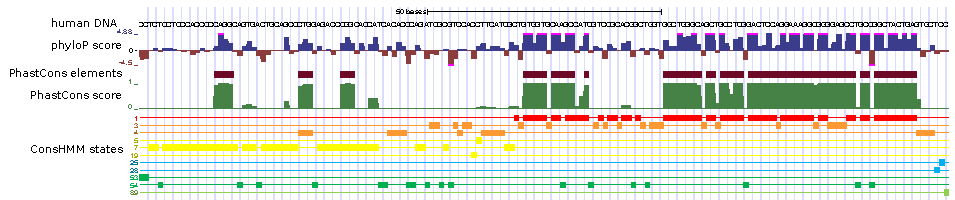
The ConsHMM Atlas provides an atlas of over twenty genome-wide ConsHMM conservation state annotations for 8 organisms.
ConsHMM annotates reference genomes at single nucleotide resolution into different conservation states based on the combinatorial and spatial patterns within
a multiple species alignment inferred using a multivariate Hidden Markov Model (HMM).
ConsHMM can also produce allele specific conservation state annotations, which are provided as part of the ConsHMM Atlas
for all possible single-nucleotide mutations in the human genome. Additionally, the ConsHMM Atlas provides visualization tools of model parameters and enrichments.
- ConsHMM genome annotations for 8 organisms
reference genomes.
See available organisms and assemblies in the table below. For some organisms and assemblies multiple different genome annotations are available
based on different multi-species alignments. Browser files for the annotations are available through here.
For the human assemblies, allele specific annotations are also available.
| Organism |
Assemblies Available |
| C.elegans |
ce11 |
| D. melanogaster |
dm6 |
| Dog |
canFam3 |
| Human |
hg19, hg38 |
| Mouse |
mm10 |
| Rat |
rn6 |
| S. cerevisiae |
sacCer3 |
| Zebrafish |
danRer7, danRer11 |
- ConsHMM R Shiny app for browsing models interactively
- ConsHMM software. ConsHMM is built on top
of the ChromHMM software for chromatin state learning.
The ConsHMM Atlas is described in:
Arneson A, Felsheim B, Chien J, Ernst J.
ConsHMM Atlas: conservation state annotations for major genomes and human genetic variation.
NAR Genomics and Bioinformatics, 2:lqaa104, 2020.
The ConsHMM software is described in:
Arneson A, Ernst J.
Systematic discovery of conservation states for single-nucleotide annotation of the human genome. Communications Biology,
2:248(2019).
Funding for the ConsHMM Atlas and ConsHMM provided by US National Institutes of Health grants DP1DA044371, R01ES024995, U01HG007912 and U01MH105578 (J.E.), and T32CA201160 (A.A.), US National Science Foundation CAREER Award #1254200 (J.E.), a Kure-IT award and an Alfred P. Sloan Fellowship (J.E.).